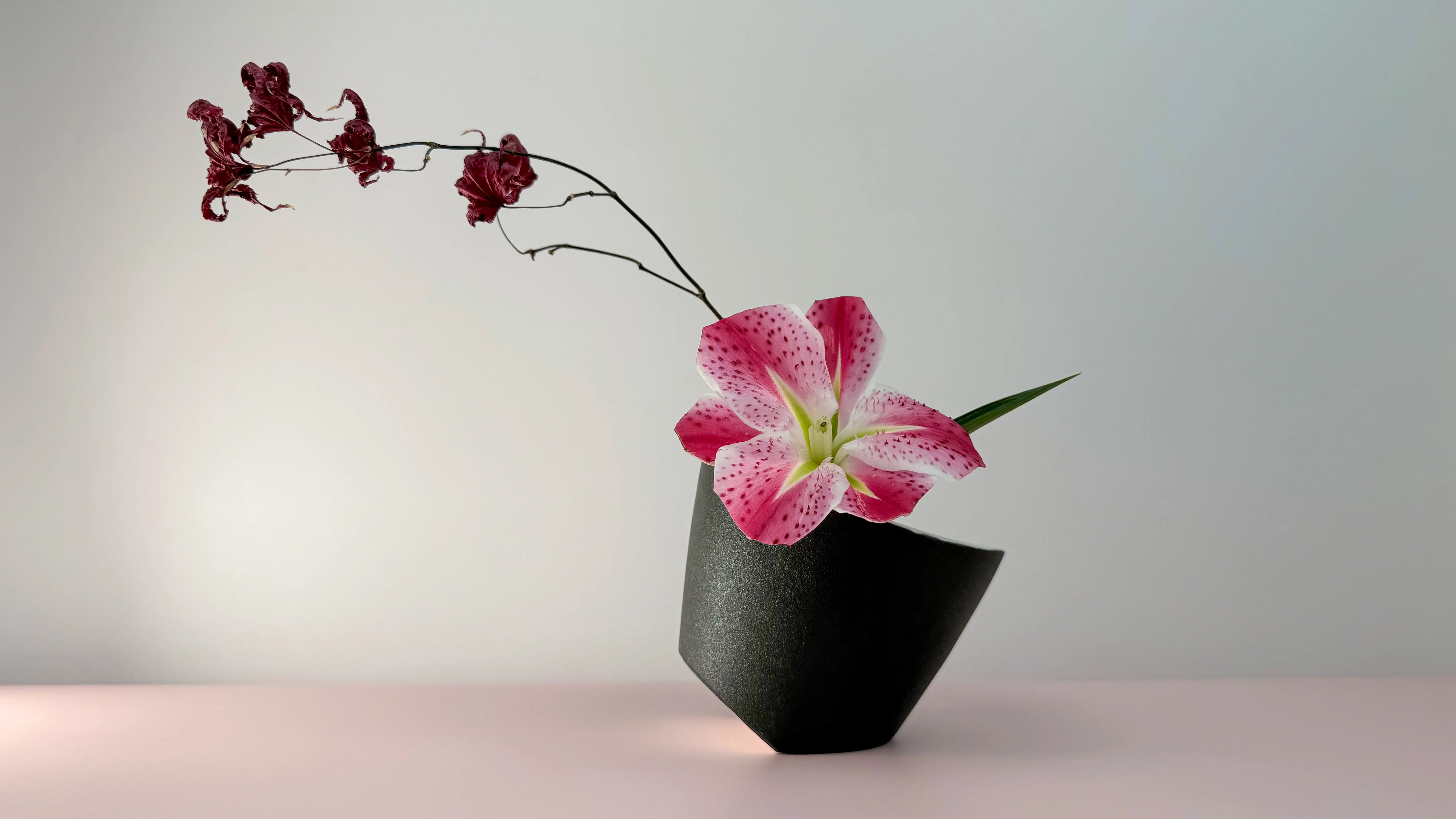
If you've stumbled on the term "zen flowers," you've probably felt the pull before you had a word for it: a single, quiet arrangement of stems and blooms, more space than flower, that somehow settles your shoulders just by looking at it. That feeling is the whole point. Zen flowers aren't a species or a bouquet style you'd order from a florist; they're a way of arranging flowers so the arrangement itself becomes a small, still moment.
The short answer
A zen flower arrangement is a minimal, deliberately composed piece of floral art where negative space, line, and asymmetry matter as much as the blooms themselves. Instead of a full, symmetrical bouquet, a zen arrangement might be three stems and a single branch, placed with real intention, closer to a piece of sculpture than a centerpiece. The goal isn't abundance. It's balance.
Where the calm comes from: ikebana
The tradition behind "zen flowers" has a name: ikebana, the centuries-old Japanese art of flower arranging. Ikebana treats each stem as a deliberate choice: how it bends, where it points, how much empty space surrounds it, rather than filling a vase as densely and symmetrically as possible. Practitioners spend years studying line, proportion, and the relationship between a living branch and the air around it.
You don't need to know the word "ikebana" to feel what it's doing. That's by design. The tradition is built around a kind of quiet attentiveness; the same quality that makes a good arrangement pleasant to simply sit with, whether or not you know its history. "Zen flowers" is, in a sense, the plain-language door into ikebana: the feeling first, the name second, if you ever want it.
Why "zen" specifically
Zen Buddhism and ikebana share a lot of DNA; both value restraint, presence, and the idea that a small, well-considered gesture says more than an elaborate one. A zen flower arrangement asks you to slow down and notice a single branch the way a zen garden asks you to notice a single raked line in gravel. Neither is trying to impress you with volume. Both are trying to give your attention somewhere quiet to land.
Zen flowers as digital art
Not everyone has the time, space, or fresh stems on hand to practice ikebana themselves, and that's where the idea of zen flowers as ambient art comes in. Instead of arranging flowers by hand, you can surround yourself with photographs of real, hand-composed arrangements: on your phone during a coffee break, on an iPad propped on the counter, or playing quietly on an Apple TV in the background of a room.
That's the idea behind Zen Flowers, an app built around exactly this: over 500 real ikebana arrangements, composed and photographed by hand, presented one at a time like a slow breath, with optional soundscapes for when you want the moment to go a little deeper. There's no feed to scroll, no algorithm optimizing for your attention; just one arrangement, held on screen, for as long as you want to look at it.
A few ways people use it
- A morning reset. A minute with a single arrangement before the day gets loud.
- An Apple TV screensaver with intention. Instead of generic aerial drone footage, a living room that quietly cycles through real floral art.
- A gift for someone who needs to slow down. No subscription, no ongoing cost; just a calm space that's theirs.
The takeaway
"Zen flowers" describes a feeling as much as a technique: minimal, intentional, unhurried floral art rooted in the real tradition of ikebana. You don't need to study the art form to benefit from it; you just need somewhere quiet to look. That's what a well-made zen arrangement, on a table or on a screen, is for.
Keep reading
- Zen flower arrangements: what makes an arrangement feel zen, with examples from the gallery.
- Ikebana and zen: how Japanese flower arranging and a calm aesthetic meet.
- Zen floral art: digital floral art for quiet screens.